

Categories
Selling your Home, The Real Estate MarketPublished July 30, 2026
How Overpricing Quietly Kills A Listing

The $39,000 Mistake: How Overpricing Quietly Kills a Listing
What the Venice market's own numbers reveal about why homes expire and what it really costs to find out the hard way
If your home was listed and didn't sell, it's tempting to blame the market. Rates, buyers on the sidelines, "nobody's spending money right now." It's a comfortable story, because it puts the reason outside your control.
But the local data tells a different and honestly a more hopeful story. Homes in the Venice area are still selling, and selling quickly when they're priced right. Over the last twelve months, across single-family homes from $500,000 to $1,000,000 in the 34285, 34292, and 34293 ZIP codes, 748 homes sold. The ones that didn't sell share one thing in common, and it isn't the market.
Here's what the numbers actually say, and what it costs a seller to learn it the expensive way.
Homes that sell, sell quickly
The most useful number for any seller isn't the "average days on market" figure in the headlines, that gets dragged up by a handful of badly overpriced homes that sit for months before capitulating. The number that matters is the median days a sold home takes to go under contract.
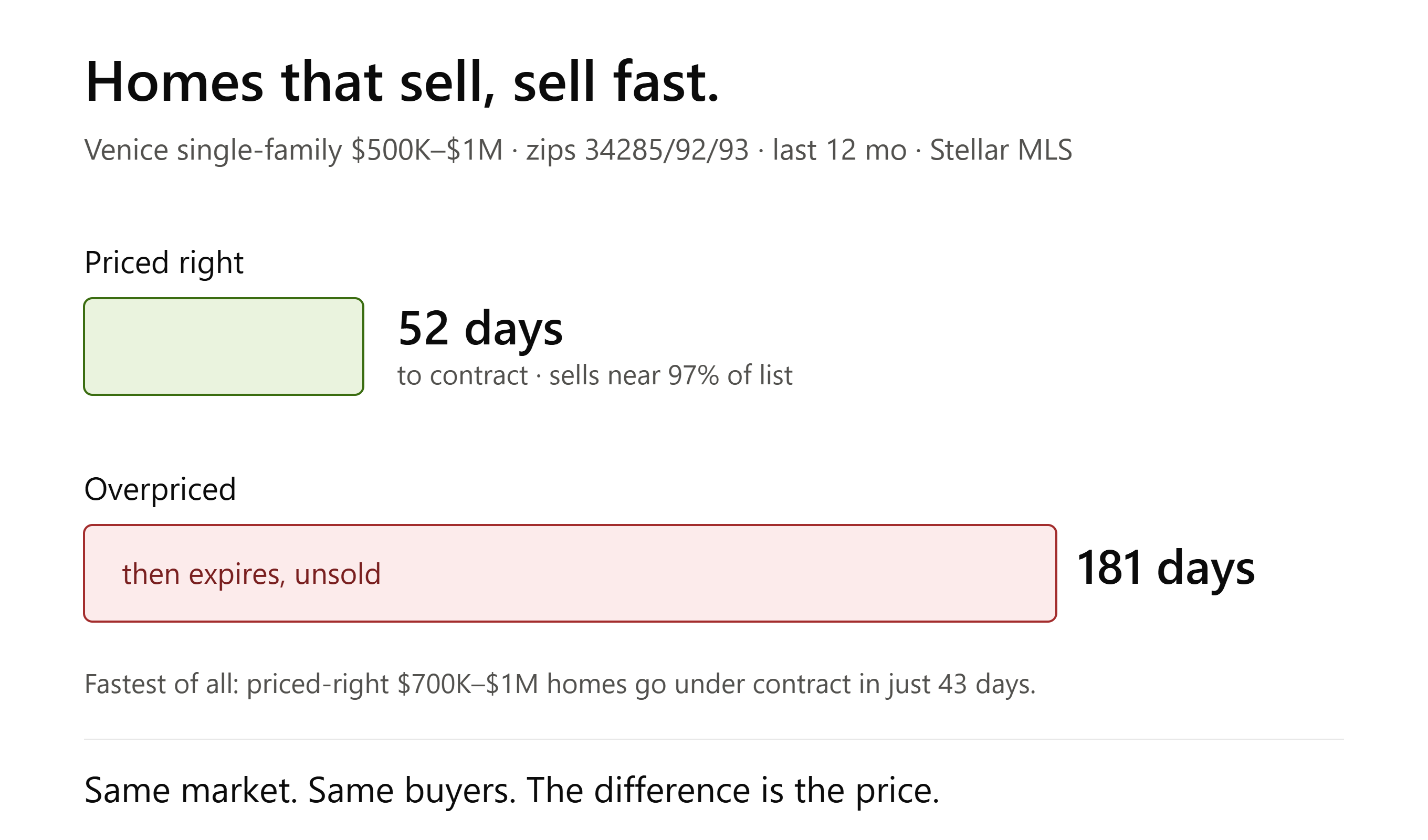
In this segment, the Stellar MLS data is clear: sold homes went under contract in a median of 52 days, and closed at roughly 97% of their final list price (and about 94% of their original list, once you count the price cuts along the way). Homes that sold got an accepted offer in about seven weeks.
Expired listings? They sat a median of 181 days before their sellers gave up - three and a half times longer. Same market. Same buyers. Same ZIP codes. The variable separating those two groups is price and positioning.
There's a detail here worth underlining, because it's counterintuitive and it matters: the higher-priced homes sold fastest. Priced-right homes in the $700K–$1M band went under contract in a median of just 43 days, quicker than the $500–700K band's 58. Well-priced move-up and luxury homes don't sit around and when the number is right, the right buyer is already waiting.
And this is a tight market which makes overpricing even more costly
Single-family inventory in this segment is running about 2.8 months ,genuinely tight. In a market this thin, homes that are priced correctly don't linger; buyers have limited choices and move on the good ones. Which makes an overpriced listing stand out for exactly the wrong reason: while correctly-priced competitors sell around it in seven weeks, the overpriced home just ages in plain sight. A tight market doesn't rescue a bad price, it spotlights it.
Why overpricing doesn't just "sit there". It actively destroys value
Overpricing feels harmless. The logic goes: "We'll start high, we can always come down." But a listing isn't a static price tag waiting for the right buyer. It's a living thing with a shelf life, and overpricing kills it in four specific ways:
1. You miss your own buyers. The most motivated, most qualified buyers have been watching a price band for months. They know value instantly. When your home lists 15–20% high, those exact buyers, the ones most likely to pay you the most filter it out and never book a showing.
2. You sell the competition instead of your home. An overpriced listing becomes the expensive comparison that makes every other home in the neighborhood look like a deal. You spend your own equity helping your neighbors sell.
3. The listing goes stale and stale has a stigma. After 30, then 60, then 90 days, buyers stop asking "why do I love it?" and start asking "what's wrong with it?" Days-on-market is public. A high number reads as a red flag, and the buyers who circle back come in low, expecting a desperate seller.
4. The appraisal problem. Even if an optimistic buyer agrees to an inflated number, the home still has to appraise. In a market that has normalized off the 2022 peak, a stretch price can blow up the deal weeks later after you've already lost your best buyers and burned months.
The cruel irony: overpricing, meant to capture more money, almost always nets less and charges you rent the entire time it's failing.
A representative case study: the $780,000 listing that sold for $650,000
The following is an illustrative composite based on documented local pricing patterns. The property is representative, not a specific address but every cost rate below is real and current, drawn from Sarasota County tax data, Florida insurance costs, and local community fee structures.
Picture a well-kept home in one of Venice's gated communities. True market value, based on honest comparable sales, is right around $650,000.
The owners anchor to the peak. A neighbor sold for $740,000 back in 2022, and theirs is nicer. They list at $779,900.
Here's how it plays out and it mirrors the pattern the MLS data shows again and again:
- Months 1–2: Almost no showings. The motivated $650K buyers never see it; the few who do use it to justify buying elsewhere.
- Month 3: A timid $20,000 price cut. Too small to matter. The market has already moved on.
- Months 4–6: A second cut into the $730s. Still chasing, never catching. Days-on-market crosses 180 right at the median for homes that expire.
- Month 6: The listing expires, unsold.
- The relist: With fresh eyes and honest pricing at $665,000, the home finally attracts real buyers and after about seven weeks, closes at $650,000.
Total time from first listing to close: roughly eight to nine months. Had it been priced at $665,000 on day one, it very likely sells near $650,000 in about the segment's median 52 days.
The overpricing didn't get more money. It got ~$12,000 less on the final price and it ran the carrying-cost meter for six extra months.
What those six extra months actually cost
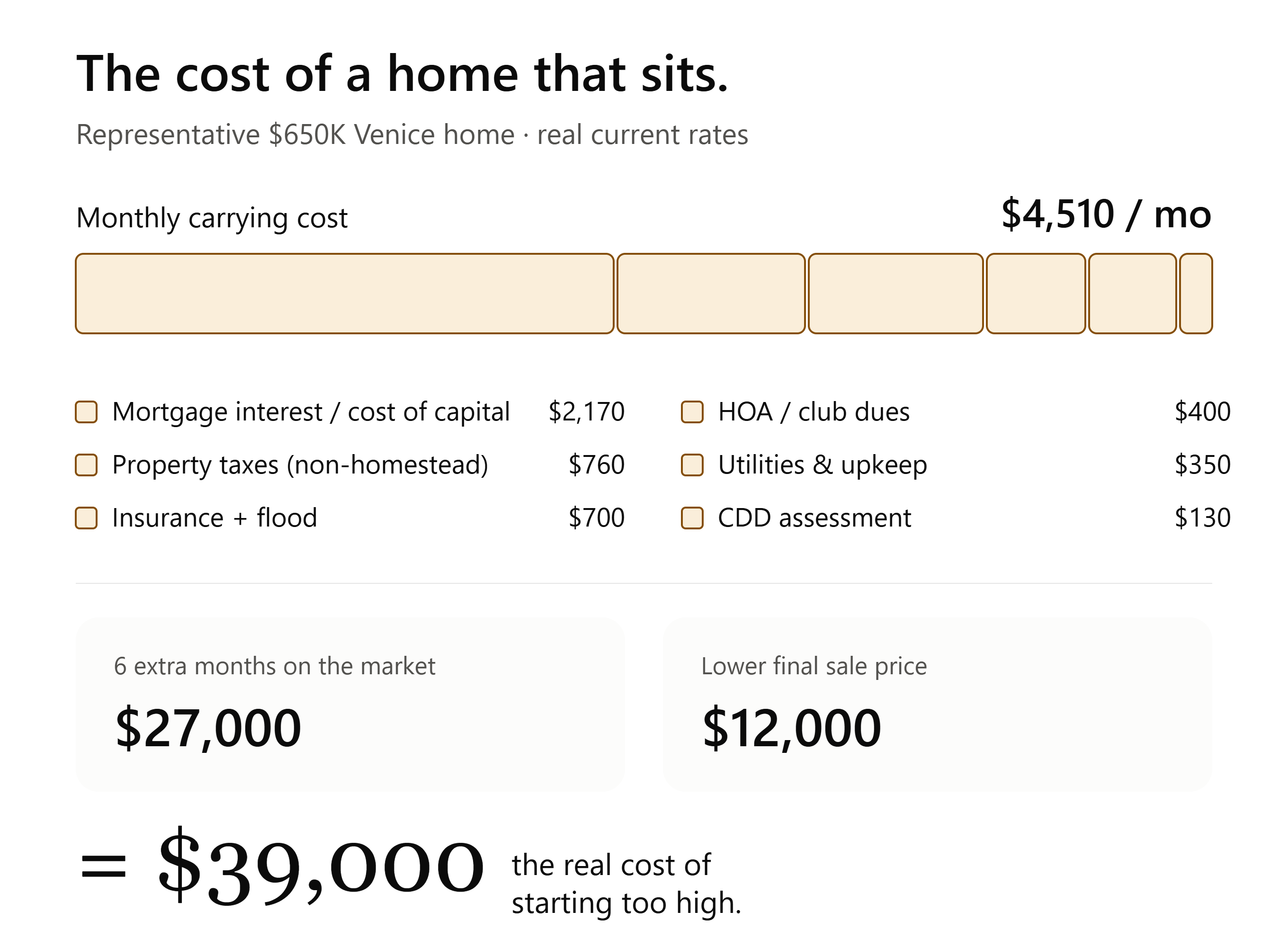
Here's the monthly carrying cost on this representative $650K Venice-area home, using real current rates:
| Carrying cost (monthly) | Amount | Basis |
|---|---|---|
| Mortgage interest / cost of capital | ~$2,170 | ~$400K balance at ~6.5% |
| Property taxes | ~$760 | Non-homestead, ~1.4% of value (Sarasota Co.) |
| Homeowners insurance (wind) + flood | ~$700 | Coastal Venice home, ~$8,400/yr |
| HOA / club dues | ~$400 | Community + amenity fees |
| CDD assessment | ~$130 | ~$1,560/yr on the tax bill |
| Utilities + upkeep (AC, lawn, pest) | ~$350 | Kept up even while vacant |
| Total | ~$4,510 / month |
Over the six extra months the home spent overpriced and unsold, that's roughly $27,000 in pure carrying costs — money that bought nothing but time on the market.
Now stack it up:
- ~$27,000 in extra carrying costs
- ~$12,000 in a lower final sale price (stale-listing discount)
- = ~$39,000 — the real, all-in cost of starting too high
Thirty-nine thousand dollars. To learn a pricing lesson the data could have taught for free on day one.
This isn't rare it's nearly one listing in three
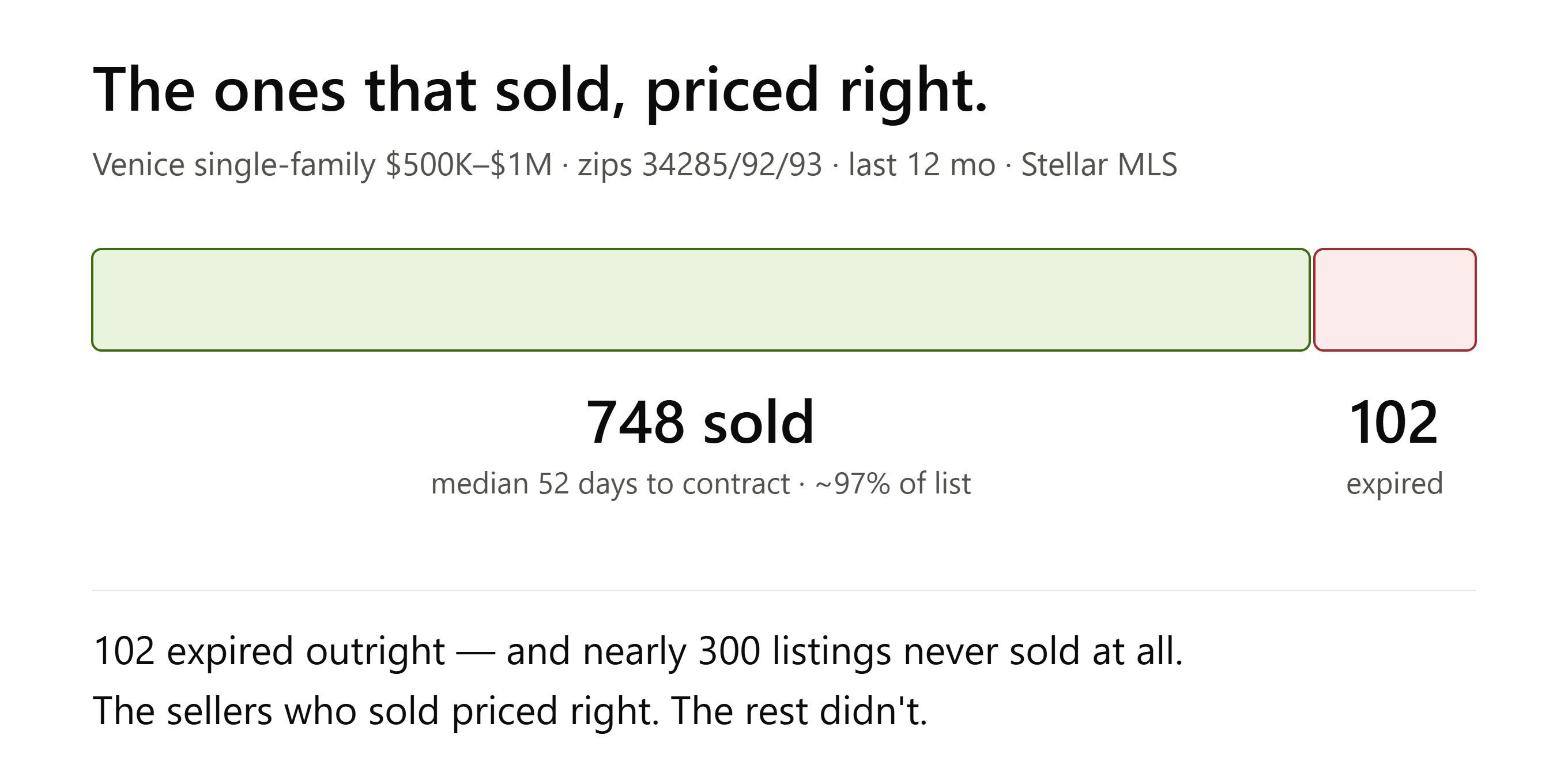
If you think the expired listing is the unlucky exception, the numbers say otherwise. In this same segment over the trailing twelve months, 748 homes sold but 102 listings expired outright, and nearly 300 in total left the market without ever selling (expired, canceled, or withdrawn). That's close to three in ten.
And here's the tell that shuts down the "it was priced fine, the market was just soft" excuse: expired homes listed at a median of $629,500, essentially the same as what sold homes listed at. The expireds weren't asking more on paper. They were priced wrong for their specific home and condition and time on the market is what exposed it.
What this means for you
If your listing expired, here's the honest and genuinely encouraging takeaway: it almost certainly wasn't the market, and it wasn't your home. Buyers are active. Homes are selling in about seven weeks. Sellers are getting the vast majority of their asking price. Your home didn't sell because of where it was positioned relative to what today's buyers will pay and that is the single most fixable thing in all of real estate.
The peak-of-2022 number is gone for everyone. But a home priced correctly for today's market doesn't sit, doesn't go stale, and doesn't bleed thousands a month while you wait. It sells often faster, and frequently for more net dollars in your pocket, than the "aim high and negotiate" approach ever delivers.
You've already paid for the expensive lesson once. Let's make sure the relist is the one that actually gets you to the closing table.
Colleen Waldoch , Broker Associate® | Seaside Living Group at HomeSmart | 941-468-5555 | colleenwaldoch@gmail.com | seasidelivingfl.com
Market statistics are sourced from Stellar MLS for single-family homes priced $500,000–$1,000,000 in ZIP codes 34285, 34292, and 34293, for the trailing twelve months. Figures are for general information, are not a guarantee of future results, and are not a valuation of any specific property. The illustrative example is a representative composite, not an actual property; carrying-cost figures are estimates and vary by property, exemptions, flood zone, and current rates. This is not tax, legal, financial, or appraisal advice . Please consult the appropriate licensed professional.
Portions of this content were prepared with the assistance of AI tools and reviewed for accuracy by Colleen Waldoch, Seaside Living Group at HomeSmart.

Colleen Waldoch
| Seaside Living Group | Colleen Waldoch | Compass
or another way