
Categories
Places to VisitPublished May 7, 2026
Exploring Florida

Dry Tortugas National Park: America's Most Remote Island Wilderness
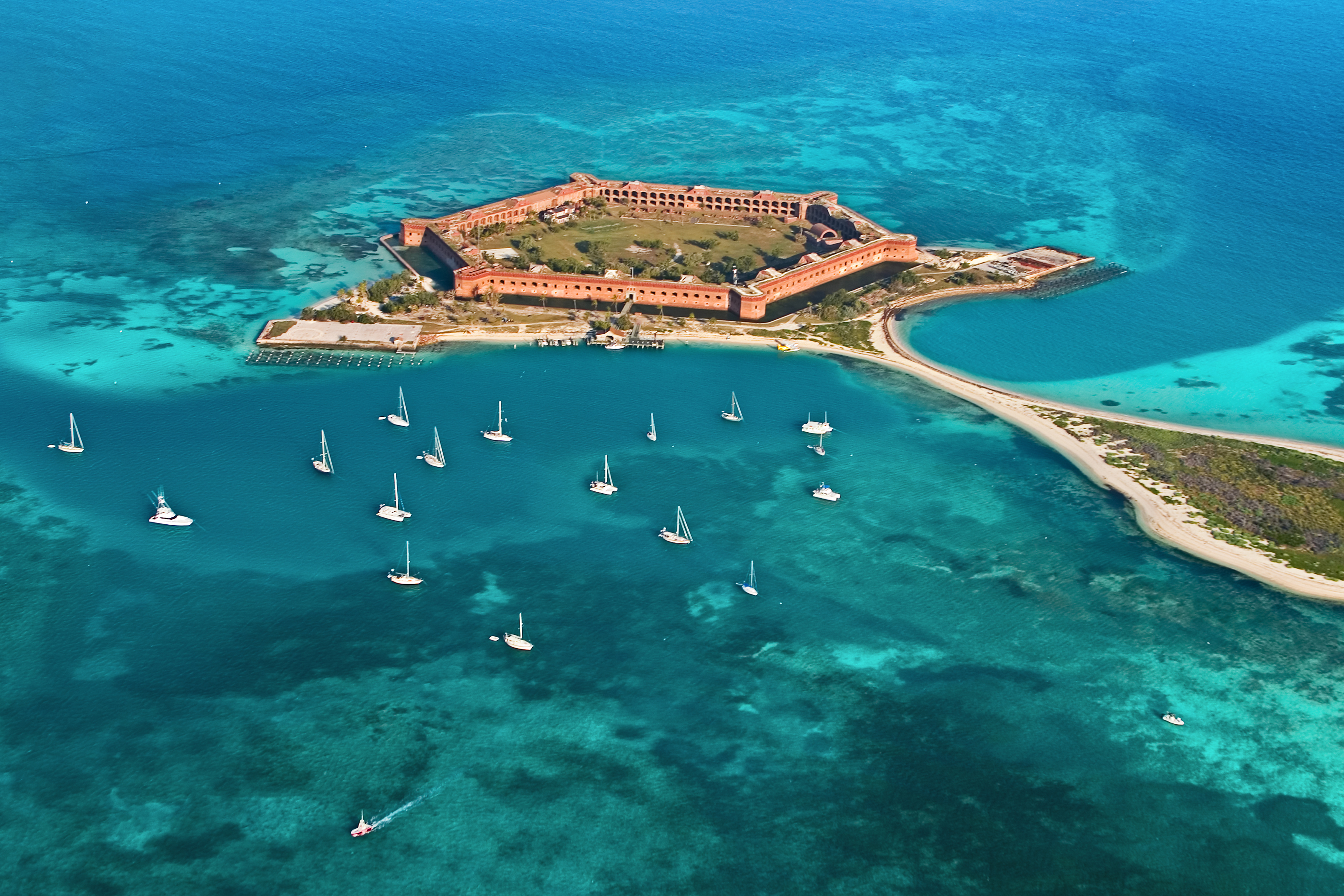
Seventy miles west of Key West, where the Gulf of Mexico shakes hands with the Atlantic, sits a national park that most Americans will never visit — and that's part of what makes it magical. Dry Tortugas is one of the least-visited national parks in the country, and there's a simple reason for that: you can't drive there. You can't bike there. You can't even walk there. The only way in is by ferry, seaplane, or private boat, and once you arrive, you're standing on a 100-square-mile patch of open ocean dotted with seven tiny coral islands.
It is, in a word, worth it.
A Park That's 99% Water
Most national parks are defined by what's above the waterline — towering cliffs, ancient forests, jagged peaks. Dry Tortugas flips that idea on its head. Of the park's 100 square miles, less than one is actually dry land. The rest is some of the clearest, bluest, most coral-rich water in North America.
The name comes courtesy of Juan Ponce de León, who showed up in 1513, caught more than 160 sea turtles for his crew to eat (sorry, turtles), and named the place "Las Tortugas." The "Dry" got tacked on later by sailors as a warning to other ships — beautiful islands, but no fresh water. Bring your own.
Fort Jefferson: A 16-Million-Brick Mistake
The crown jewel — or the magnificent oddity, depending on how you look at it — is Fort Jefferson, a massive six-sided coastal fortress built between 1846 and 1875. It's the largest masonry structure in the Western Hemisphere, made of more than 16 million bricks, and it was never actually finished. It also never fired a shot in battle. The military eventually realized that advances in cannon technology had made brick forts obsolete before this one was even done. Oops.
But what a glorious oops it is. Walking the parade ground inside Fort Jefferson feels like wandering into a Mediterranean ruin that somehow drifted into the Caribbean. The arches stretch on forever. The brickwork has weathered into soft pinks and oranges. The moat — yes, there's a moat, in the middle of the ocean — is patrolled by curious tarpon and the occasional nurse shark.
The fort also did time as a Civil War prison. Its most famous inmate was Dr. Samuel Mudd, the physician who set John Wilkes Booth's broken leg after the Lincoln assassination. He served four years here before being pardoned, partly thanks to his work fighting a yellow fever outbreak at the fort. There's a plaque marking his cell, and it's a strange thing to stand in front of — history in the middle of nowhere.
The Snorkeling Will Ruin You for Other Snorkeling
Fair warning: once you've snorkeled at Dry Tortugas, your local aquarium is going to feel a little sad.
The waters around Garden Key and Loggerhead Key are part of the third-largest coral reef system on Earth, and visibility regularly stretches past 50 feet. You'll drift over elkhorn and brain corals, glide past parrotfish doing their parrotfish thing, and probably lock eyes with a barracuda or two. Sea turtles still cruise these waters in real numbers — a small but proper redemption for what Ponce de León's crew got up to.
The moat wall around Fort Jefferson is one of the easiest and most rewarding snorkel spots in the park. You don't need to be a strong swimmer; the water is calm, shallow, and absolutely teeming with life.
A Birder's Pilgrimage
If you're into birds — or even bird-curious — Dry Tortugas is hallowed ground. It's a critical stopover for migratory species crossing the Gulf, and the park hosts the only nesting colonies in the continental U.S. for sooty terns, brown noddies, and magnificent frigatebirds. Spring migration brings warblers, hawks, and the occasional rare visitor that sends serious birders into a happy frenzy.
Bush Key, right next to Fort Jefferson, is closed to visitors during nesting season (roughly February through September), but you can watch the chaos unfold from across the channel. Tens of thousands of birds, all yelling at once. It's wonderful.
How to Actually Get There
There are essentially three options:
The Yankee Freedom ferry runs daily from Key West. It's a 2.5-hour ride each way, includes breakfast, lunch, snorkel gear, and a guided tour of the fort. You get about four and a half hours on the island. This is how most people visit.
Key West Seaplane Adventures will fly you out in a small plane. It's pricier but stunning — you'll see shipwrecks and shallows that ferry passengers never glimpse. Half-day and full-day options are available.
If you have your own boat (or know someone with one), you can sail in. The park has a small campground on Garden Key, and camping there overnight is one of the great quiet adventures in the National Park system. Just remember the "Dry" in the name — bring every drop of water you'll need.
A Few Practical Notes
There is no food, no water, no Wi-Fi, and no cell service on the islands. Pack accordingly. Reef-safe sunscreen is essential, both for your skin and the corals. The shade situation is limited; a hat is your best friend. And if you're prone to seasickness, the ride out can be lively — bring whatever your preferred remedy is.
Why You Should Go
In a country full of crowded, Instagram-famous national parks, Dry Tortugas is an antidote. It's quiet. It's strange. It's a brick fortress in the middle of the ocean surrounded by coral reefs and sea turtles, and most days you'll share it with a few hundred people instead of a few thousand.
It's the kind of place that makes you feel small in the best possible way — small under all that sky, small next to all that water, small inside a fort built by people who couldn't have imagined you'd be standing there nearly two centuries later, blinking at the light bouncing off the moat.
Pack the sunscreen. Skip the cell phone. Go.
|


or another way